

There are over 390 different dog breeds recognized by the FCI (Fédération Cynologique Internationale).
Worldwide, there are estimated to be more than 800 different dog breeds. The FCI classifies these according to their various breed characteristics and special features. Another classification is based on their function, for example, as a family dog, hunting dog, or guard dog. A simplified categorization is based on size, measured by shoulder height.
Dogs ears
Why they can hear even fleas cough
A dog's hearing is truly fascinating. One moment it seems to be sleeping peacefully. You move slightly on the sofa, and suddenly it's standing in front of you, tail wagging. This is because all dog breeds can hear sounds in the ultrasonic range. We humans can no longer perceive these. Dogs' ears register sounds down to the infrasound frequency of below 16-20 Hz. They have 17 different muscles that make them so flexible. They can also sleep peacefully in their bed even in the greatest commotion. While doing so, they block out all background noise that is unimportant to them. But their hearing itself remains active. If it then hears a signal or a favorite sound, they are immediately alert again.
Dogs eyes
You don't have to be afraid of the dark with your dog.
Dogs of all breeds are particularly good at seeing moving images. However, unlike humans, this applies primarily to twilight or nighttime. They essentially see just as well during the day as at night. In twilight, a dog's eyes reflect incoming light twice, making them much more sensitive to light. However, a dog's eyes cannot distinguish between colors with medium and long wavelengths, such as yellow, orange, and red. Therefore, your dog won't be interested in watching television with you, but he is the perfect companion at dusk. He immediately recognizes distant movements.
Dogs nose
Your dog is an absolute pro sniffer
A dog's nose is its most frequently used sensory organ. Unlike the human nose, which has 5 million olfactory cells, a dog has up to 220 million. This allows it to track game for kilometers.
They can tell who's at the door by smell. Because of their sniffing, they can breathe up to 300 times a minute. They therefore take in many times more scent particles than humans. The area in their brain responsible for processing smells is about ten times larger than in humans. Sniffing creates scent images that can remain in a dog's memory for a lifetime.

Dog education
Every dog owner desires a harmonious life with their four-legged friend. Basic training is essential for every breed. The key is loving consistency. Dog training isn't just for professionals or large dogs! Every dog needs training. It's important that your dog learns to react calmly in various situations, such as encountering a group of people or a cyclist. Every human-dog team can therefore work together to establish some basic rules in a positive way. Otherwise, every walk can quickly become an ordeal, which is neither enjoyable for you nor your dog. Dogs aren't meant to be idle; they have a natural urge to move and learn. They respond very well to positive reinforcement training. Fears of overwhelming or even harming your dog are unfounded.
Additionally, training strengthens the bond with your dog. You become one. With basic commands, you can make your dog's everyday life more positive, relaxed, and secure. The right balance of patience, love, and consistency from you is crucial. With patience, you never need to raise your voice or be unjustifiably harsh. With consistency, you're guaranteed to reach your goal. And you should always have plenty of love ready for your dog anyway.
Our top 5 signals your dog should know and be able to understand
Our top 5 signals are training tips for all dog breeds. You can ask good dog trainers or dog schools how best to implement them.
THE RECALL
"Here"
"This way"
"Come here"
One of the most important signals! Your dog should know and obey the recall command, whether at home or on walks. You show your dog that in any situation, he should stop what he's doing and come to you immediately. A reliable and consistent recall is truly invaluable! When learned correctly, it can be used in any situation.
THE RELAX SIGNAL
"Lie down"
"Go to the bed"
"Go to blanket"
This is a signal to relax. Many dogs are restless and find it difficult to calm down. For such dogs, it's extremely important not only to constantly tire them out, but also to teach them how to relax. Use a tool like a dog blanket or something similar. This is a great help for your dog, as they will associate the relaxation exercise with this object. This creates a positive association; your dog learns blanket = relaxation. The blanket can, of course, also be used when you're out and about, so you can create this positive effect anywhere.
THE STOP SIGNAL
"Let go"
"Stop it"
"Stop that"
This signal is intended to make your dog release an object (e.g., a toy), end a situation (e.g., picking something up from the floor), or stop unwanted behavior (e.g., jumping up on people). The "leave it" signal is a very important signal for your dog's protection.
THE CONCENTRATION SIGANL
"Check"
"Look"
“Eyes”
This signal is a concentration exercise. When you give it, your dog should look at you and focus on you. This signal helps dogs that are easily distracted, making it easier for them to respond to subsequent commands.
THE STAY SIGNAL
"Sit"
"Wait"
"Stay"
With this signal, your dog should sit or lie down and wait for a follow-up signal from you. This is very helpful, for example, at feeding time. Your dog shouldn't run you over when you come with the full food bowl, but wait patiently. This allows you to calmly place the bowl on the ground. Only when you release the exercise with a follow-up signal is he allowed to go to the food bowl. During walks, your dog should also wait calmly when you stop to chat with friends. This signal is also helpful before crossing a street, as it teaches your dog to be especially attentive in these situations.

Muzzle training
Imagine this scenario: Your dog has injured his paw during a walk, and you need to take him to the vet. For safety reasons, he'll be muzzled. Your dog hasn't experienced this before. What additional fear will he feel? What memories will he retain from this? What impact will it have on future situations where he wears a muzzle? You can easily avoid this stress. Start using positive reinforcement as early as possible. Muzzle training . This way, your dog will associate wearing a muzzle with positive experiences from the very beginning. It will become completely normal. muzzle It is not a punishment, but serves an important purpose in many situations, namely to protect your dog.
When is a muzzle an important aid?
Muzzles often still have a deterrent effect on other people. Dogs with muzzle Muzzles are often seen as dangerous, or the owner as not being particularly fond of animals. However, a muzzle protects your dog. For example, it prevents them from eating, from poisoned bait, and provides protection in stressful situations such as vet visits. Of course, it also prevents bites and much more.
Each country has different regulations and requirements regarding this. Here in Austria Failure to comply with these regulations can result in sometimes severe penalties.
Wearing a muzzle may be mandatory in the following situations:
- travelling with public transport
- generally in public
- for certain specified dog breeds and all mixes of these breeds
- during vet visits
Before your holiday, be sure to find out about the regulations of the respective (federal) states.
What kind of muzzle should it be?
The basic requirement for a successful Muzzle training that your dog will also enjoy uses a comfortable muzzle that fits well.
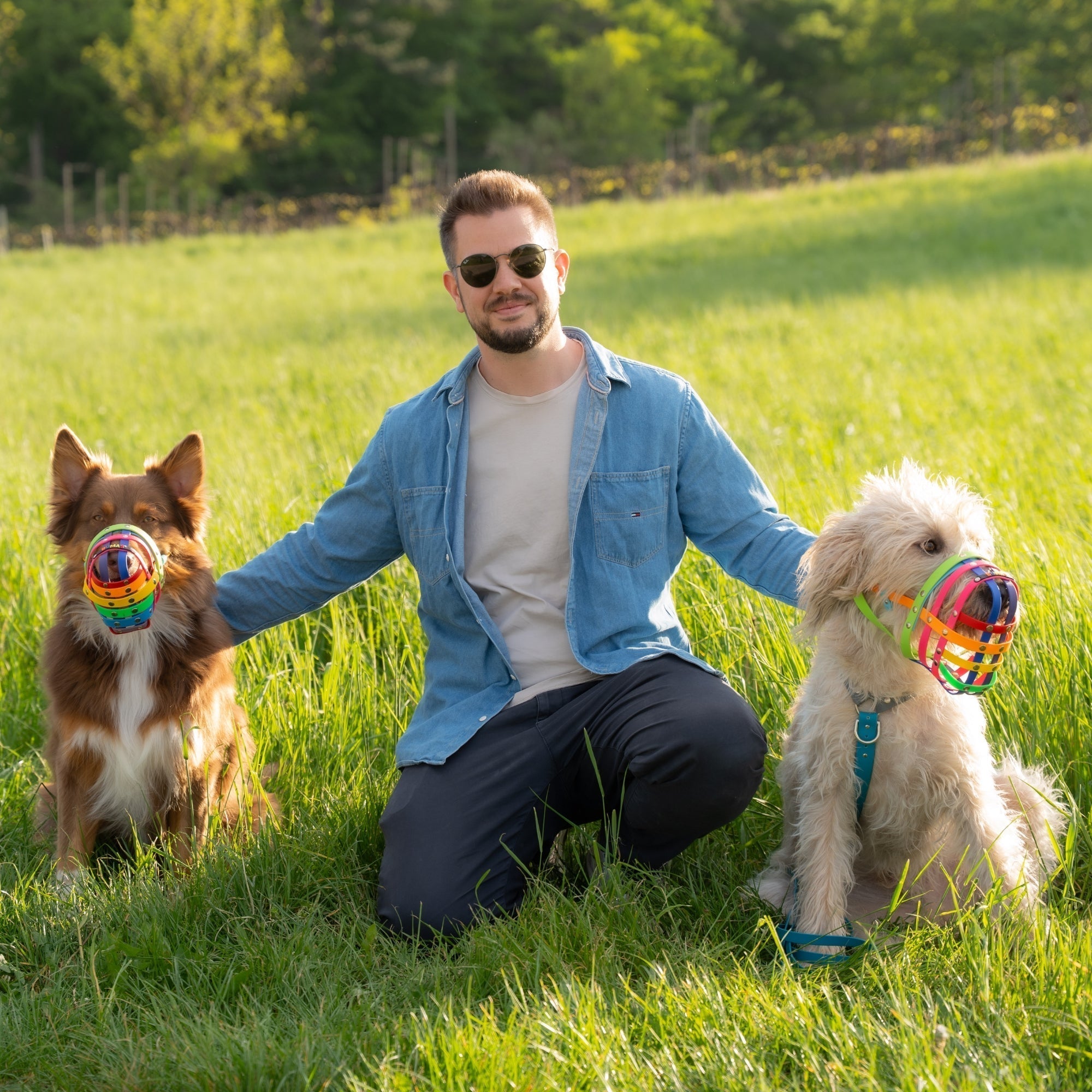
A BUMAS Provides ample room for panting and drinking. Thanks to the lightness of the soft and flexible BioThane® material, there are no sharp edges. This material far surpasses leather in tear resistance. It has been tested in temperatures ranging from -30 to +80 degrees Celsius and retains its suppleness and shape. The ergonomic fit and custom manufacturing ensure your dog wears the muzzle naturally, much like a person wears glasses. An original BUMAS muzzle protects without being intrusive.
Perfect fit
You can your BUMAS Tailored to your dog's needs and personality. That's what guarantees the perfect fit.
For your custom-made BUMAS You can choose from and combine a wide range of colors.

The ideal basic equipment for your dog
- dog collar
- dog leash
- muzzle
- Food bowl and water bowl
- dog bed




Split:
Small dog breeds